
Artbreeder Review: AI Image Generator, Pricing & My Test Results
My rating
A fast, clean generator with plain terms. Small lettering still fails.
Best for: quick pictures of people and products. Not for signs or labels with small wording.

Tested and written by Miles Foster
Based on 7 graded tests and my verdict. How I rate
I tested Artbreeder hands-on on its free plan, giving its AI image generator 10 of my 40 fixed prompts. I timed each image, downloaded one and read the terms. Artbreeder ranks #6 of the ten on my best AI image generators page.
Every measurement is in the Artbreeder test results.
My Artbreeder AI Image Generator Test Results
| Category | Grade | In short |
|---|---|---|
| Prompt AdherenceMost details right, busy scenes miscounted | 4/5Good | |
| Photorealism & AnatomyMost pictures pass as photos, one printed mark failed | 4/5Good | |
| Text in ImagesBig headlines right, small lines garbled | 3/5Average | |
| Resolution & UpscalingNormal size, upscale not checked | 3/5Average | |
| Speed per ImageAbout eight seconds for each picture | 5/5Excellent | |
| Usage Rights, Watermarks & PrivacyFree images are public domain, no label | 2/5Below average | |
| Pricing & ValueFew free pictures, cheap paid month | 4/5Good | |
| My verdict | +0.4 | |
| Overall | 4.0/5Good |
What Is Artbreeder?
Artbreeder is a set of AI image tools from Morphogen, Inc. The Prompter turns a written prompt into a picture, and other tools mix images, build collages and expand a picture.
You pay in credits. The free plan gives 3 credits a month, and one image costs a small fraction of a credit up to well over half a credit, depending on the model you pick. Paid plans start at $7.49 a month when you pay yearly.
How I Tested Artbreeder
Every image generator gets the same 40 written prompts, and I keep the first image of each. On the free plan I ran 10 of them and seven of the ten tests, and left three tests out. I stopped with half a credit left.
My tools
Last checked 12 Nov 2026Artbreeder pros and cons
Pros
- An image in about 8 seconds
- Clean people and products
- 51 of 59 details right
- Images free for any use
- No watermark on the download
- Many tools beyond text to image
- Free plan needed no card
Cons
- Small lettering comes out garbled
- Busy scenes miscount objects
- Free images are public domain
- Only about 12 Flux images a month free
- No content credentials in the file
- Private mode needs a paid plan
Artbreeder Pricing
The cheapest plan is $8.99 a month for Starter, or $7.49 a month if you pay yearly. The free plan costs nothing and you enter no card. Credits cost about $0.09 each on the monthly plan, so you pay about $0.022 for a Flux image.
Advanced is $18.99 a month and Champion $38.99. Prices read on 12 November 2026.
Artbreeder plans and prices
Live data· last check 12 November 2026| Plan | Price a month | |
|---|---|---|
| Free3 credits a month, all models but Krea 2 Large | $0 | 3 credits a month, all models but Krea 2 Large |
| Starter100 credits a month, private mode, no ads | $8.99 | 100 credits a month, private mode, no ads |
| Advanced275 credits a month | $18.99 | 275 credits a month |
| Champion700 credits a month | $38.99 | 700 credits a month |
- Monthly billing costs more per month than yearly billing for each plan
- Credits reset each billing period and do not roll over
- No enterprise plans listed
I did not buy a plan, so the per-image cost assumes a paid image costs the same credits as a free one. An upscale takes a small extra charge on top.
Artbreeder Prompt Adherence
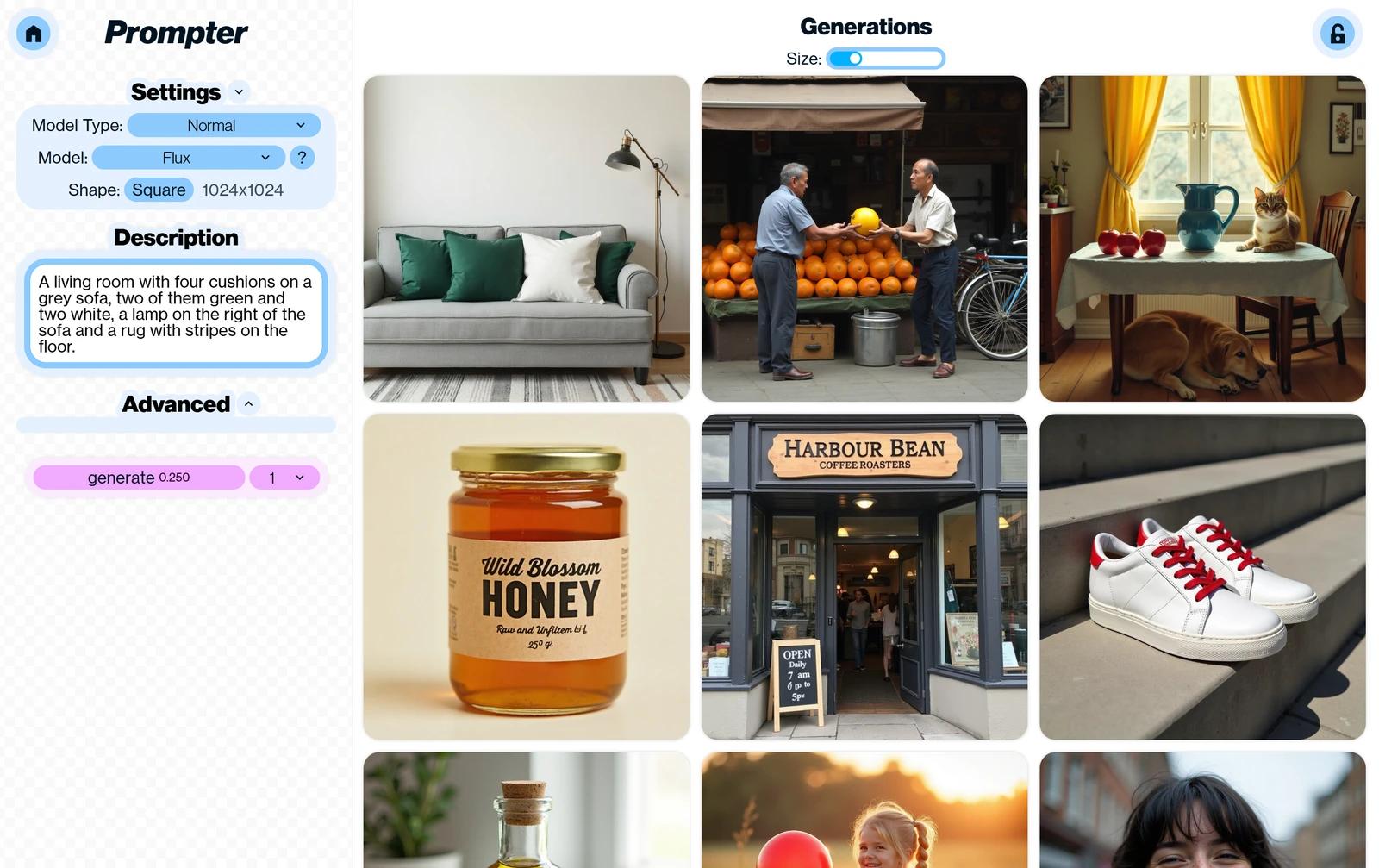
Artbreeder got 51 of 59 asked-for details right across my 10 prompts. Portraits and products were nearly perfect. The busy scenes were where it slipped: the cat sat on the table instead of the chair, the oranges were a pile instead of five in a row, and the sofa had three green cushions instead of two.
The man on the bench wore square glasses, not the round ones I asked for. When you ask for exact counts, check the picture.
Artbreeder Photorealism
Artbreeder made four of five images that pass as photographs. The man on a bench, a laughing woman, a girl with a red balloon and an olive oil bottle had good skin, eyes, teeth, hands and light.
The one failure was a printed mark on the tongue of the trainers that looks like letters and spells nothing. I ran five images once, not 24 twice.
Artbreeder Text in Images
Artbreeder got 14 of 19 words right. The big lines were perfect: "Harbour Bean Coffee Roasters" on the shop sign and "Wild Blossom Honey" on the label.
The small lines failed. The board reads "OPEN Daily 7 am 6 rp to 5pk", and the label reads "Raw and Unfiltem". No image was fully correct, and both carried extra tiny lettering I never asked for.
Artbreeder Image Size and Upscaler
Artbreeder makes images 1,024 pixels square, about 1 megapixel, as JPEG. The widest frame is 1,280 by 768 and the tallest is 768 by 1,280. The Download button gave the same file, with no watermark.
An upscale costs under a fifth of a credit. I did not run it, because it would have taken the account past the 85 percent line I set for credits, so I cannot tell you how clean it is.
Artbreeder Speed per Image
Artbreeder took a median of 8.0 seconds for each image across 10 generations. The fastest took 7.2 seconds and the slowest 8.3.
You wait about 8 seconds for every picture, whatever the prompt. Nothing failed and there was no queue on the free plan.
Artbreeder Free Plan Limits
Artbreeder gives 3 credits a month on the free plan. The Flux model costs a quarter of a credit an image, so a month holds 12 images. I made 10 and stopped with half a credit left; the balance refills to 3 on 6 December.
Cheaper models cost far less: SDXL Lightning is about fifteen times cheaper than Flux and Flux Schnell about eight times. I kept to Flux for every image, so the style, character and editing tests did not fit. Animator and private mode need a paid plan, so you pay before you can keep work private.
Artbreeder Usage Rights
On every plan you own your Artbreeder images, and everyone else may use them. The terms say each image is owned by its creator, and that you license every image under CC0, which releases it into the public domain for any purpose.
That makes business use simple, because you can put the pictures on a product or a site. The costs are privacy and proof: private mode is paid, the terms offer no way to opt out of training on your prompts, and the file carries no content credentials label. The download had no watermark.
Final verdict: is Artbreeder worth it?
Artbreeder is worth trying if you want quick, clean pictures of people and products and plain terms that let you use them anywhere. It drew every image in about eight seconds, counted most of what I asked for and gave me a file without a watermark.
It is not the tool for posters, signs or labels with small wording, because those lines came out garbled. Busy scenes still miscount objects, and every image is released into the public domain, so do not use it for anything private.
The seven tests I could run average 3.6 out of 5. I rate it 4.0 because the free plan let me run seven of the ten tests.
See the Artbreeder test results and how I rate.
Best for: People who want fast, clean pictures of people and products with a few free tries a month, and plain terms that let them use the images anywhere.
Video review · 4:15
Watch me test Artbreeder
The whole test with the screen recordings: prompts, timing, wording, rights and prices. Captions and the full transcript are one click away, and the video has a page of its own.
Transcript
Hi, I'm Miles. I tested Artbreeder, an A I image generator, on its free plan. Here's the short version. It drew every picture in about eight seconds and got fifty-one of fifty-nine details right. But small lettering came out garbled, and the free plan pays for only about twelve Flux images a month. My rating is four point zero out of five, from the seven tests I could run.
So what is Artbreeder? It's a set of A I image tools. The Prompter turns a written prompt into a picture, and other tools mix images, build collages and expand a picture. You pay in credits, and the free plan gives you three a month.
Every generator gets the same written prompts. I ran ten of my forty. Portraits and products were nearly perfect. The busy scenes were harder. The cat sat on the table, not the chair. The oranges were a pile, not five in a row. And the sofa had three green cushions, not two.
For photos, four of five passed. The man on the bench, the laughing woman, the girl with the balloon and the olive oil bottle all look real. The trainers carry a printed mark that looks like letters and spells nothing.
Text is the weak spot. I asked for a shop sign and a honey label. The big lines were perfect. The small lines were not. The board reads, six r p to five p k, and the label reads, Unfiltem. In all, fourteen of nineteen words were right.
Images come out at one thousand and twenty-four pixels square, as JPEG. The download had no watermark. There's an upscale button, but I didn't press it, because it would have taken me past my credit limit.
Speed is the best part. Across ten images the median was eight seconds. The fastest took seven point two, and the slowest eight point three. Nothing failed, and there was no queue.
The free plan is small. Three credits a month, and the Flux model costs a quarter of a credit an image. I made ten images and stopped with half a credit left. That is why I could not run the style, character and editing tests.
The terms are plain. Each image is owned by the person who made it, and every image is released into the public domain, so business use is fine. But private mode costs money, and there is no way to opt out of training.
The cheapest plan is Starter, eight ninety-nine a month, or seven forty-nine if you pay yearly. A Flux image then costs about two cents. I did not buy a plan to check.
My verdict: Artbreeder is worth trying for quick, clean pictures of people and products. But don't use it for signs or labels with small wording. The seven tests average three point six, and I rate it four point zero out of five. The full results are on the test results page.
Chapters · 13
Frequently asked questions
How much does Artbreeder cost, and is there a free plan?
Yes. The free plan gives 3 credits a month; I made 10 Flux images from it. Starter, the cheapest plan, is $8.99 a month, or $7.49 a month paid yearly.
Is Artbreeder legit and safe?
Yes, in my test. I signed in with Google, entered no card and was never charged. The terms name the company, Morphogen, Inc. Free images are public domain.
Who owns the images I make with Artbreeder?
You do, and so may everyone else. The terms say each image is owned by the user who created it, and that every image is released under CC0, into the public domain.
Can I use Artbreeder images commercially?
Yes. The CC0 terms allow any purpose on every plan. I did not buy a plan to test it, and the terms were last updated in 2019.
What did you not test?
Three tests. Style range, consistency and editing were left out: the free credits were nearly used up, and changing to a cheaper model halfway would have changed the test. The upscale was priced but not run.

Miles FosterOwner and tester, RankDudeMiles Foster is a pen name: the owner of RankDude, a private person, runs every test himself.
Disclosure. I tested on the free demo account anyone can open on Artbreeder’s site. I signed up myself and paid Artbreeder nothing. Artbreeder didn’t see this review first and had no say in my rating. How RankDude makes money is on the disclosure page.