
Bolt.new Review: AI App Builder, Pricing & My Test Results
By Miles Foster, Owner and tester, RankDude. Tested , published .
My rating
A fast builder whose first version was broken and whose access rules let a member become admin, but data, export and every change held up.
Technical founders who will check what it builds.
Based on 8 graded tests and my verdict. How I rate

Prefer to listen or watch? A 4-minute walkthrough, or the 10-minute video. Sound on.
I gave Bolt.new one message, a $25 Pro plan and a made-up Pilates studio. About twelve minutes later it had built the studio's booking app. Then I tried to use it: 24 written checks, two attempts to reach data I should not see, twelve changes a studio owner would ask for, the data panel, a code download, publishing and a cost count.
Every measurement is in the Bolt.new test results.
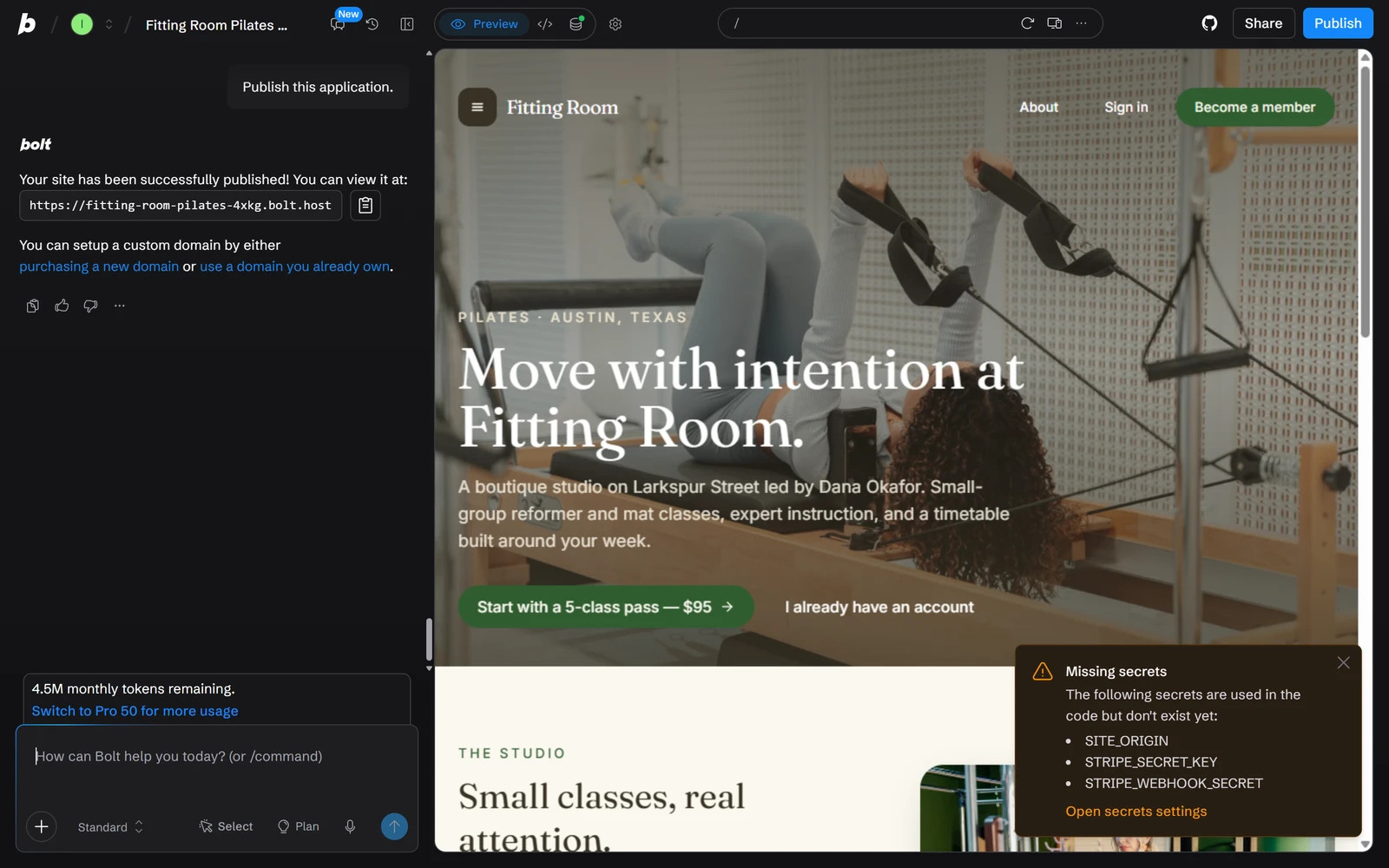
What I paid for, and what I built on Bolt.new
Live and monitoredI built one app, from one brief, on a paid Pro plan. Apart from my fix and test changes it is exactly as built:
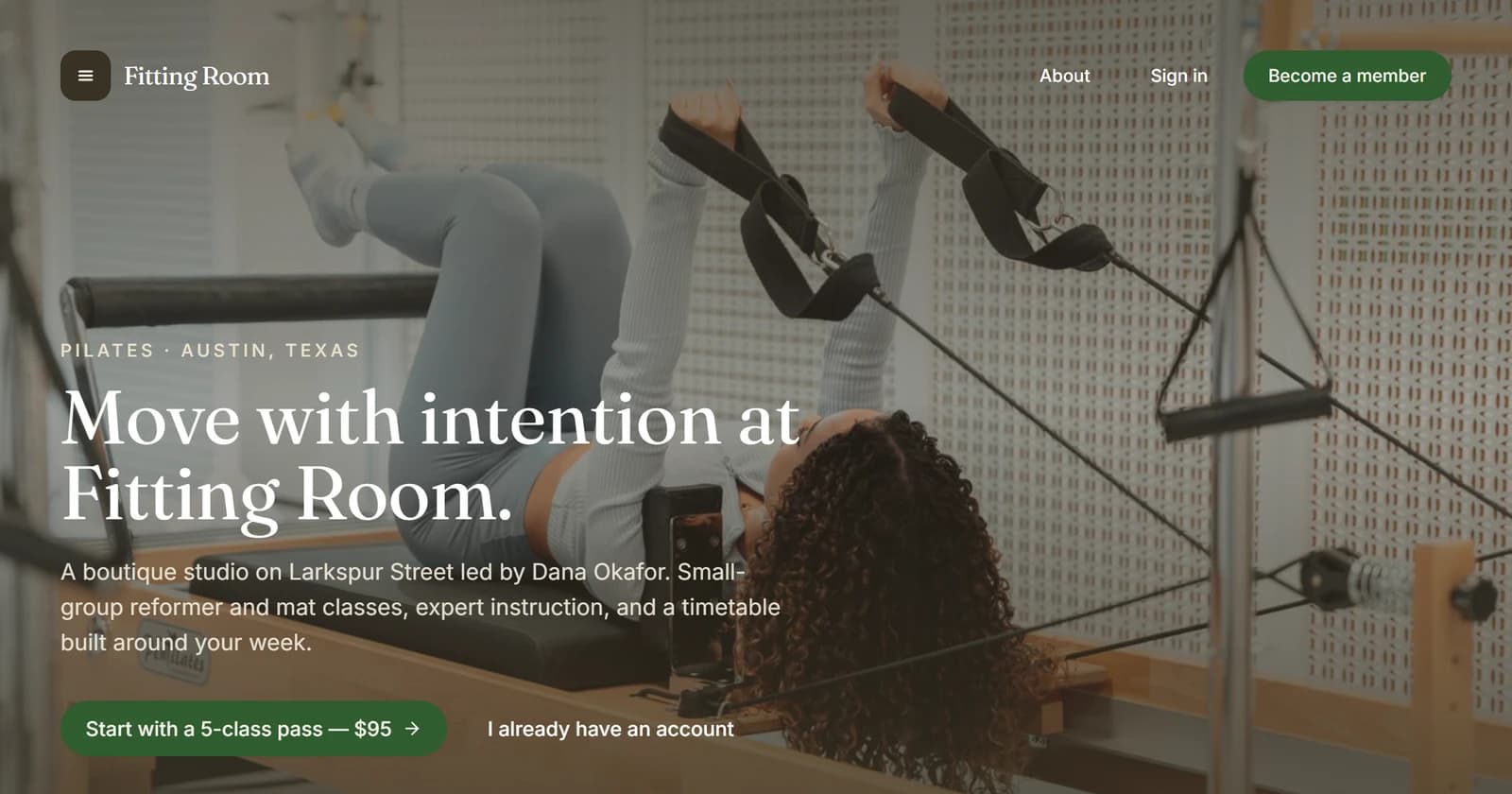
Fitting Room
Pilates studio booking app, built on the Pro plan, on Bolt.new's address.
Open the Bolt.new test app ↗It runs on Bolt.new's servers, whatever the address. See the proof
My Bolt.new AI App Builder Test Results
| Category | Grade | In short |
|---|---|---|
| Prompt to working appLive fast, but the first version was broken | 4/5Good | |
| Brief accuracyAlmost every check passed in the end | 4/5Good | |
| Logins and securityA member could make themselves admin | 3/5Average | |
| Data survivesEvery data check passed, panel and export | 5/5Excellent | |
| Twelve changesAll twelve changes worked, one message each | 5/5Excellent | |
| Publish, speed, mobileOnline in two minutes, fair phone speed | 3/5Average | |
| Code exportDownloads as a normal project that builds | 4/5Good | |
| Cost to finishHalf the monthly tokens did the whole job | 4/5Good | |
| My verdict | +0.0 | |
| Overall | 4.0/5Good |
What Is Bolt.new?
Bolt.new builds a working web app from a chat. You describe the app in plain words. Bolt.new writes the screens, sets up a database, adds log-in, and hosts the app online. Want something changed? You type another message.
You pay in tokens, which the chat spends every time it builds or changes something. The $25 Pro plan I bought gives 10 million tokens a month. Payments and emails are not built in: Bolt.new asks you for your own Stripe and email keys, so I left them out of the tests.
How I Tested Bolt.new
Every number here comes from my own tests and my own monitors. Nothing is estimated or copied, Bolt.new never saw the review first, and every app builder gets the same brief, checks, changes and attempts.
My tools
Bolt.new pros and cons
Pros
- Working app from one message in 12 minutes
- Twelve changes, one message each
- Data panel and export all worked
- Code downloads as a plain project
- Other members' data stayed private
- Whole test used 5.5M of 10M tokens
Cons
- First version had broken links and a crash
- Booking could not work until a fix
- A member could make themselves admin
- Password reset link points to localhost
- Export needs your own Supabase to run
Bolt.new Pricing
The $25 Pro plan was enough to build and change my test app, using about half of its tokens. Prices read on 26 October 2026, paid month by month; paying for a year costs less.
Bolt.new plans and prices
Live data· last check 26 October 2026| Plan | Price a month | What you get |
|---|---|---|
| Free | $0 | A free plan exists; I did not read its limits |
| Pro | $18 | 10 million tokens a month, own domain, no Bolt branding. The plan I tested |
| Teams | $27 | Per member, shared capacity and team controls |
| Enterprise | Custom | Annual contract, billed by consumption |
Bolt.new Cost: What My Test App Really Cost
Here is the number everyone asks about first. In total I paid $25: one month of Pro, plus tax. The whole test used 5.5 million of the plan's 10 million tokens, which is 55% of the month. At the plan price that is about $13.75 of tokens; the first working version alone is about $5.25.
What my app cost
| What I paid for | Cost |
|---|---|
| One month of Pro | $25 |
| First build, tokens | 1.3M tokens |
| Five fix messages used | 0.8M tokens |
| Twelve changes used | 3.4M tokens |
| The whole test | 5.5M of 10M tokens |
| Total I paid | $25 |
Running the app costs more than building it. Payments and emails need your own accounts at Stripe and an email service, so their fees are not in this number, and I could not measure them.
Bolt.new Build Speed: One Message to a Live App
About twelve minutes after my one message, the first version was ready. Bolt.new asked two design questions, which I skipped, and told me it needed my Stripe keys. I give every app builder the same brief: a class timetable, members who book, coaches who see only their own classes, an admin who runs the studio, and a $95 five-class pass.
Looking good was not working. The sign-in and sign-up buttons led to pages that do not exist, so the published app sent every visitor back to the home page. One fix message put that right.
Four more faults followed: an admin page that crashed, booking that could never succeed, and admin and coach screens that showed no bookings. Five fix messages took about 0.8 million tokens. After the last one, 1 hour 25 minutes after my message, 23 of the 24 checks passed, which is a 4 on the published scale.
Bolt.new Accuracy: Did It Build What I Asked?
Almost. 23 of 24 checks passed on the finished app; I left out the six payment and email checks because they need your own keys. The one that failed is the password reset, whose link goes to localhost.
The ten facts from the brief were all correct. Bolt.new also added things nobody asked for: a "Most popular" tag on the pass, "Monday through Saturday" wording and stock photos. The timetable shows a weekly pattern with day tabs, not dated classes.
Bolt.new Editing: Twelve Changes Tested
I asked for twelve changes a studio owner would want. Among them: a phone number field, a renamed role, new colours, an About page, a filter, a waiting list, a dark mode, and a bug I planted on purpose. All twelve finished with one message each, and a quick check of the three kinds of user after each one found nothing broken.
Twelve changes, one message each
| What happened | Changes |
|---|---|
| Finished in one message | 12 of 12 |
| Could not be checked | 1 (the second email, because the app sends no emails without keys) |
| Broke something that already worked | 0 found |
Each change took one to seven minutes. All twelve used about 3.4 million tokens, and dark mode alone used about 0.9 million. One change, the class size, was only a data edit and made no new version. I ran a short check after each change, not all 30 checks again.
Bolt.new Publishing and Page Speed
Publishing took under two minutes, from a chat message, with no extra cost. After each later change you press an Update button in the Publish dialog. I did not connect my own web address.
Going live
| What I measured | Result |
|---|---|
| First publish took | under 2 minutes |
| Google phone speed score | 78 of 100 |
| Own domain name | not tested |
Google's phone speed test, out of 100
- Run one79
- Run two78
- Run three77
On Google's phone speed test the home page scored between 77 and 79 out of 100, and the main content took about four seconds to appear. I ran only the home page, did not count layout faults at different widths and did not test on a real phone.
Every day I also run the Bolt.new speed test and the Bolt.new security checks.
Bolt.new Uptime: 30 Days of Checks
A review tells you what happened on one day. This tells you what happens every day after. My own monitor opens the app every five minutes for 30 days, from 26 October to 25 November 2026, and records whether it answered and how fast.
Bolt.new hosts the app, so a Bolt.new outage would show here. The app runs on Bolt.new's own address, so there is only one address to watch.
Every check so far is on the Bolt.new uptime record.
Bolt.new uptime test
Live data· last check 26 Oct 2026, 14:17 UTC100%
Online
947 ms
Answer time
0
Outages
Is it really Bolt.new serving this app? Yes. The address ends in bolt.host, the app publishes from Bolt.new's own button, and the data sits in the database panel inside the Bolt.new editor. RankDude itself runs elsewhere.
Bolt.new Security: Logins and Private Data
A member made themselves an admin, with one request. I replayed the app's own data requests with a member's session. Reading other members' bookings, profiles, credits and orders returned nothing of theirs: that attack was blocked. But one request that set my own role to admin was accepted, and the app then treated me as an admin. Class edits and deletes by a member were refused. I put the role back afterwards.
The everyday parts mostly worked: sign-up for members, coaches and the admin, log-in, log-out and staying signed in after a reload. The password reset email arrived within seconds, but its link opened a page on my own computer, so a new password could never be set on the published app.
The first admin account is created with a code that Bolt.new printed in the chat. It works once. I did not run Bolt.new's security audit.
Bolt.new Database: Does the Data Survive?
Bookings and contact-form messages were saved as real records, and Bolt.new's own data panel passed all six checks. I viewed the classes table, filtered it, added a row, deleted it and exported the table as CSV and as JSON. After all twelve changes the five classes were still there.
The panel also has tabs for security, authentication, users, server functions, file storage, secrets and logs. I used only the data tab.
Bolt.new Payments and Emails
I did not test payments or emails. Bolt.new does not set up Stripe or an email service for you: it needs your own Stripe secret key and webhook secret and an email key, and I gave it none. The six checks that depend on them are left out of the grade.
What I saw without keys: the Passes page said Stripe was being set up, so no checkout opened, and the admin outbox read "No emails sent yet" after several bookings. To keep testing booking, I asked Bolt.new to give every member 5 free credits, for my testing only.
Bolt.new Code Export and Ownership
This is the section to read before you pay. Exporting means taking your app's code and running it somewhere else. In the project menu, Download gave a zip of 66 files on the second try (the first attempt showed no file). It is a Vite and React project with the database migrations and three server functions in a supabase folder.
I found no Bolt-specific code in it. It installed and built cleanly on my own computer in 3 seconds. To run it elsewhere you need your own Supabase project, the migrations applied, the functions deployed and two values set. I did not run it end to end, and I did not read Bolt.new's terms, so I cannot say who owns what you build.
Bolt.new Support and Cancellation
Bolt.new's email support is for paid plans only. Its Help Center points free plans to Discord. The Help Center assistant could not be used, because it failed browser verification, so I emailed my question to support@bolt.new on 26 October 2026. I will add Bolt's reply here when it comes.
Cancelling the Pro plan took four steps on 26 October: Settings, Subscription & Tokens, Billing details, then Cancel subscription. Bolt.new warns that branding returns, private sharing switches off and banked tokens become inaccessible, then asks for a reason and some free text. The plan moves to Free after 25 November 2026, and the app and projects stay.
Bolt.new Reviews: What Other Users Say
Trustpilot says 2.1 and I say 4.0, so here is the gap. On Trustpilot, Bolt.new scores 2.1 out of 5 from 213 reviews (read 26 October 2026). Trustpilot's own summary of recent reviews lists the same complaints: the AI crashing, using too many tokens, struggling to fix its own mistakes, and slow support.
My test is one app over two days. I did meet some of it: a crash, a booking button that never worked and five fix messages. Support has not replied yet, so I cannot judge it. If you plan to build for months, read those reviews too.
Final verdict: is Bolt.new worth it?
If this were my studio, I would use Bolt.new with a developer beside me. Bolt.new is worth trying if you will check what it builds and can supply your own Stripe and email keys. It made a nice-looking app in twelve minutes, every later change worked in one message, and the code downloads as a project you can run yourself.
It suits technical founders who want a fast start on a booking or admin app. It suits you less if you cannot read a fix report, because the first version had broken links, a crash and booking that could not work, and a member could make themselves admin.
The eight graded tests average 4.0 out of 5, and I rate Bolt.new 4.0. Payments and emails need your own keys and support awaits Bolt's reply, so neither is graded.
See the Bolt.new test results and how I rate.
Best for: Developers and technical founders who will fix what the first build gets wrong and can supply their own Stripe and email keys.
My rating: 4.0/5, from a test score of 4.0/5. The ten grades say where it is strong and where it is not.
Video review · 10:04
Watch me test Bolt.new
The whole test in about ten minutes: one message to a booking app, 24 checks, two attacks, twelve changes, the code download, cancelling, the cost to finish and the prices. Captions and the full transcript are one click away.
Transcript
Hey, I'm Miles, and this is RankDude, where I test AI tools hands on and publish every number, so you can decide before you pay. Today it's Bolt.new, an AI app builder. You describe an app in a chat, and it builds the screens, the database, the log-in and the hosting. I tested it on a paid Pro plan, twenty-five dollars a month, with one brief for a Pilates booking app called Fitting Room. The short version is that Bolt.new built the app from one message in about twelve minutes, but the first version was broken. Five fix messages put that right, and twenty-three of my twenty-four checks passed. One of my two attacks got through, because a member could make themselves admin. All twelve changes worked, and the code downloads as a project you can run. My rating is four out of five. That's the average of eight tests, with nothing added for my verdict.
So, what is Bolt.new? You get a chat box, a live preview, a data panel and hosting. You say what you need, and the AI writes the screens, sets up the database, adds the log-in and hosts the app. After that, every change is another message. And Bolt.new charges in tokens, which the chat spends every time it builds or changes something. Pro gives ten million tokens a month. Payments and emails are not built in. It asks you for your own Stripe and email keys, so I left them out of my tests.
Every builder I review gets the same brief, word for word. Fitting Room is a booking and membership app for a small Pilates studio. It has a timetable, members who book, coaches who see only their own classes, an admin, and a ninety-five dollar five-class pass. I pasted the brief in one message. Bolt.new asked two design questions, which I skipped, and told me it needed my Stripe keys. About twelve minutes later, the first version was ready, using about one point three million tokens. I published it from the chat in under two minutes. Looking good was not working. The sign-in and sign-up buttons led to pages that do not exist, so every visitor went back to the home page. An admin page crashed. Booking could never succeed, and the admin and coach screens showed no bookings. Five fix messages took about zero point eight million tokens. After the last one, one hour and twenty-five minutes after my message, twenty-three of the twenty-four checks passed. On my scale, the build earns a four.
Now accuracy. I ran the twenty-four checks that need no keys of my own against the live, published app, by hand and with scripts, with one screenshot for each. I left out the six payment and email checks, because they need your own keys. The final app passed twenty-three of twenty-four. The one that failed is the password reset, whose link goes to localhost. All ten facts from the brief were correct. But Bolt.new added three things nobody asked for: a Most popular tag on the pass, Monday through Saturday wording, and stock photos. The timetable shows a weekly pattern with day tabs, not dated classes. Accuracy scores four.
Log-in, and the two attacks. Sign-up worked for members, a coach and the admin, and a session survived a reload. The first admin account is created with a one-time code that Bolt.new printed in the chat. The password reset email arrived in eleven seconds, but its link opened a page on my own computer, so a new password could never be set on the published app. Attack one. I'm member A, and I ask for other members' bookings, profiles, credits and orders. Blocked. I got only my own rows. Attack two. A member calls admin-only actions. Editing or deleting a class was refused. But one request that set my own role to admin was accepted, and the app then treated me as an admin. I put the role back afterwards. One of two attacks blocked, so access control scores three.
Next, the data. The contact form and the bookings wrote real records, and they were still there after a republish and a design change. In Bolt.new's own data panel, I viewed the classes table, filtered it, added a row, deleted it, and exported the table as a CSV and as a JSON file. After all twelve changes, the five classes were still there. The panel listed ten tables. All six checks passed. Five out of five.
Payments and emails. I did not test them. Bolt.new does not set up Stripe or an email service for you. It needs your own Stripe secret key, a webhook secret and an email key, and I gave it none. The six checks that depend on them are left out of the grade. Here is what I saw without keys. The Passes page said Stripe was being set up, so no checkout opened. The admin's email outbox read No emails sent yet after several bookings. To keep testing booking, I asked Bolt.new to give every member five free credits, for my testing only.
Then I made twelve changes, one message each. Things like a phone field on sign-up, a renamed role, new colours, an About page, a filter, a waiting list, a dark mode toggle, and a bug I planted on purpose. After each one, I ran a short check as a member, a coach and the admin, not all the checks again. All twelve finished with one message each, and nothing that already worked broke. One change, the class size, was only a data edit and made no new version. One check, the second email, could not be done, because the app sends no emails without keys. Each change took one to seven minutes. All twelve used about three point four million tokens, and dark mode alone used about zero point nine million. Five out of five.
Publishing. Bolt.new put the app online in under two minutes, from a chat message, with no extra cost. After each later change, you press an Update button in the Publish dialog. I did not connect my own web address, so I can't say how that goes. On Google's phone speed test, the home page scored seventy-nine, seventy-eight and seventy-seven out of a hundred, and the main content took about four seconds to appear. I only ran the home page, did not count layout faults at different widths, and did not test on a real phone. That earns a three.
Can you take the app with you? Yes. In the project menu, Download gave me a zip of sixty-six files on the second try, because the first attempt showed no file. It's a Vite and React project, with the database migrations and three server functions in a Supabase folder. I found no Bolt-specific code in it. It installed and built cleanly on my own computer in three seconds. To run it elsewhere, you need your own Supabase project, the migrations applied, the functions deployed and two values set. I didn't run it end to end, and I didn't read Bolt.new's terms, so I can't say who owns what you build. Export scores four.
Support and cancelling. Bolt.new's email support is for paid plans only, and its Help Center points free plans to Discord. The Help Center assistant failed browser verification, so I emailed my question to support on the twenty-sixth of October. I'll add the reply to the written review when it comes. Cancelling the Pro plan took four steps: Settings, Subscription and Tokens, Billing details, then Cancel subscription. Bolt.new warns that branding returns, private sharing switches off and banked tokens become inaccessible, then asks for a reason. The plan moves to Free after the twenty-fifth of November, and the app and projects stay. Support is not graded yet.
What did it cost to finish? In total I paid twenty-five dollars: one month of Pro, plus tax. The whole test used five point five million of the plan's ten million tokens. That's fifty-five percent of the month, about thirteen dollars seventy-five at the plan price. The first build used one point three million tokens, the five fixes zero point eight million, and the twelve changes three point four million. Running the app costs more than building it, because payments and emails need your own accounts, and their fees aren't in this number. The next plan up is fifty dollars a month, for twenty-six million tokens.
What do other users say? On Trustpilot, Bolt.new scores two point one out of five from two hundred thirteen reviews, which I read on the twenty-sixth of October. Trustpilot's summary of recent reviews lists the AI crashing, using too many tokens, struggling to fix its own mistakes, and slow support. My test is one app over two days. I did meet some of it: a crash, a booking button that never worked, and five fix messages. Support hasn't replied yet, so I can't judge it.
Pricing. Bolt.new has a free plan, but I didn't read its limits. Pro is twenty-five dollars a month, billed monthly, for ten million tokens, with your own domain and no Bolt branding. Teams is thirty dollars per member, and Enterprise is a custom contract. Paying for a year costs less. Finishing my app took about half of Pro's tokens, so Pro was enough to build and change it. Pricing scores four.
So, my verdict. Bolt.new is worth trying if you'll check what it builds, and can bring your own Stripe and email keys. It made a nice-looking app in twelve minutes, every later change worked in one message, and the code downloads as a project you can run yourself. The weak points are a first version with broken links, a crash and booking that couldn't work, and a member who could make themselves admin. I'd use it with a developer beside me. The eight graded tests average four point zero out of five, and my rating is four out of five. Payments and emails need your own keys and support awaits a reply, so neither is graded. Every measurement, every screenshot and every price is in the written review and the test results, linked below.
Chapters · 15
Frequently asked questions
How much does Bolt.new cost, and is there a free plan?
The Pro plan is $25 a month billed monthly, for 10 million tokens. There is a free plan, but I did not read its limits. My whole test used 5.5 million tokens, about $13.75 of the plan.
Is Bolt.new legit and safe?
Legit, but check what it builds. One message gave a live app in about twelve minutes. Other members' data stayed private, but a member could make themselves admin with one request, so check your access rules before real users arrive.
Who owns what I build with Bolt.new?
Not checked. I did not read Bolt.new's terms, so I cannot say who owns the code or the data. The download holds plain project files with no Bolt-specific code, but read the terms first.
Can I download my Bolt.new code?
Yes. Project menu, Download gives a zip of 66 files: a Vite and React project with Supabase migrations. It installed and built cleanly on my computer, but it needs your own Supabase project to run.
How do I cancel Bolt.new?
In four steps. Settings, Subscription & Tokens, Billing details, Cancel subscription. It warns that branding returns, private sharing switches off and banked tokens become inaccessible, and asks for a reason. The plan moves to Free after 25 November 2026 and your projects stay.

Miles FosterOwner and tester, RankDude
Disclosure. I tested on a Bolt.new plan RankDude paid for at the public price. Bolt.new didn’t see this review first and had no say in my rating. How RankDude makes money is on the disclosure page.